
Assessing safety culture maturity – from within
Making the invisible drivers of safety performance visible, discussable, and actionable.
What is the Safety Culture State Review – from within?
The Safety Culture State Review (SCSR) is a structured assessment approach designed to identify the current and desired maturity level of a company-specific safety culture.
Unlike externally imposed models or benchmark-driven assessments, the SCSR deliberately follows a “from within” approach:
It captures how safety is actually perceived, practiced, and lived inside an organisation — across leadership, management, and the operational workforce.
The SCSR translates collective perceptions and behaviours into a transparent maturity profile, enabling organisations to:
- understand where their safety culture truly stands today,
- define a realistic and company-specific target state, and
- derive focused development actions aligned with their operational reality.
Safety culture is not something that can be copied from best-practice examples or imposed through rules alone.
It must fit the organisation’s identity, history, and way of working.
Major Disasters Point to Cultural Issues
Detailed investigations of major industrial disasters across high-risk industries repeatedly reveal a common pattern:
Deficiencies in safety culture were a decisive contributing factor.
Whether in oil & gas, chemicals, aviation, or space exploration, accident investigations consistently show that catastrophic events rarely result from a single technical failure. Instead, they emerge from a combination of:
- tolerated deviations and workarounds,
- weakened standards and shortcuts,
- ineffective leadership signals,
- misaligned priorities under pressure, and
- deeply embedded assumptions about acceptable risk.
These factors are not visible in procedures or systems alone.
They originate in the invisible layers of organisational culture.
The SCSR was developed precisely to address this challenge:
to make cultural drivers of safety performance visible, discussable, and manageable — before they contribute to serious or major accidents.
- July 6th, 1988
Piper Alpha Oil Rig Disaster - March 25th, 2005
BP’s Texas City Refinery Disaster - December 11th, 2005
Buncefield oil depot exploded
Link to HSE published report - February 1st, 2003
Columbia Explosion - April 20th, 2010
Deepwater horizon disaster
Culture, Safety Culture, and Organisational Culture
Culture
Culture describes the shared patterns of thinking, feeling, and reacting within a group.
It is shaped over time, transmitted through symbols and behaviours, and rooted in shared values and historical experiences.
In simple terms, culture defines “how things are really done around here.”
Safety Culture
Safety culture is not a separate culture.
It is a specific expression of the overall organisational culture, focusing on those values, attitudes, and behaviours that directly influence safety-related decisions and actions.
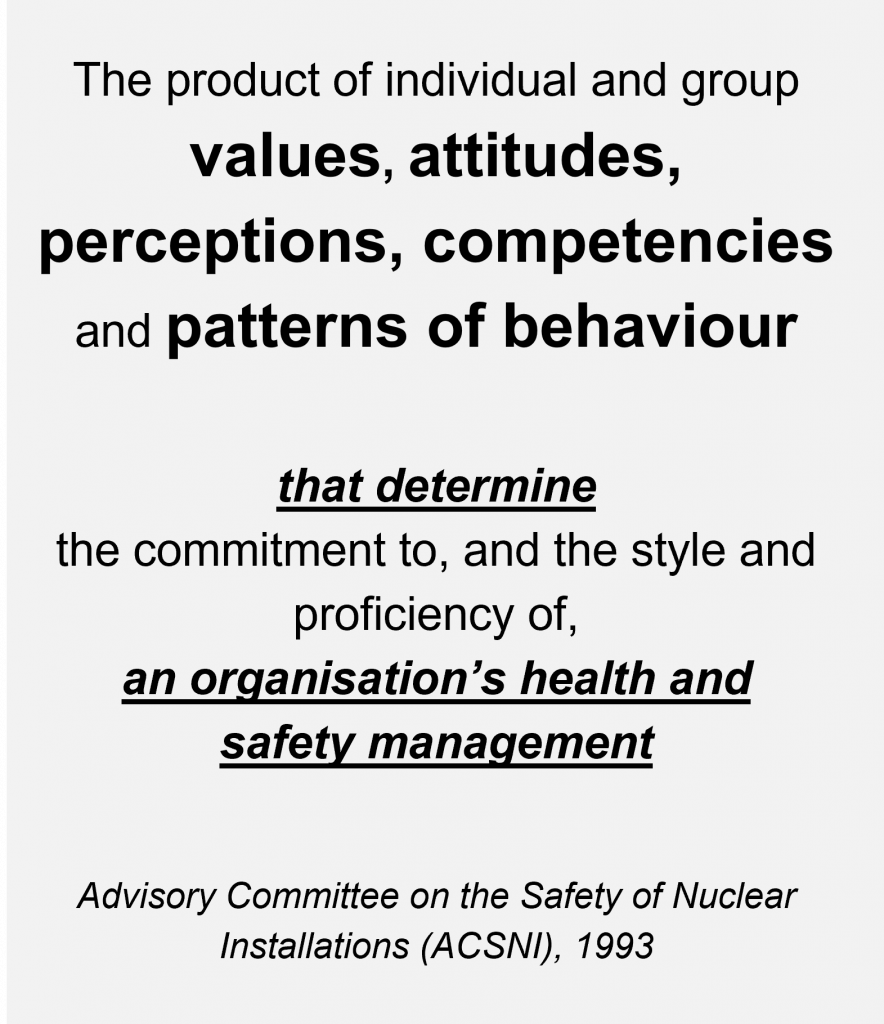
As defined by the Advisory Committee on the Safety of Nuclear Installations (ACSNI, 1993), safety culture reflects:
- individual and group values,
- attitudes and perceptions,
- competencies and behavioural patterns,
that determine the commitment to safety and the style and effectiveness of the safety management system.
In practice, this means:
Even a well-designed Safety Management System will underperform if the underlying culture does not support its intent.
Organisational Culture and Safety Performance
Safety culture is inseparable from organisational culture.
Leadership behaviour, decision-making under pressure, communication patterns, and responses to deviations all stem from the same cultural foundation.
A widely used and intuitive description captures this perfectly:
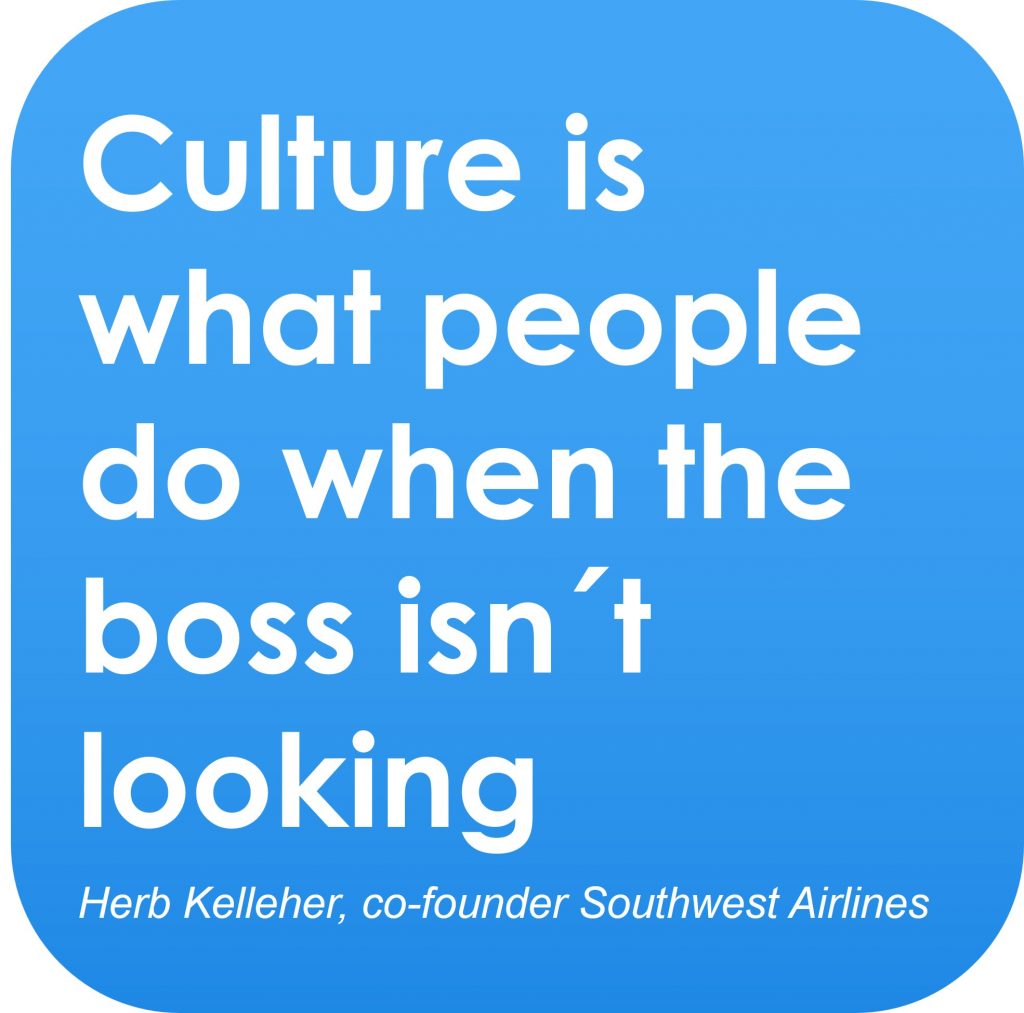
“Culture is what people do when the boss isn’t looking.”
— Herb Kelleher, co-founder of Southwest Airlines
This applies directly to safety.
Rules define expectations — culture determines behaviour when procedures no longer provide clear answers.
The Safety Culture Model – Making the Invisible Discernible
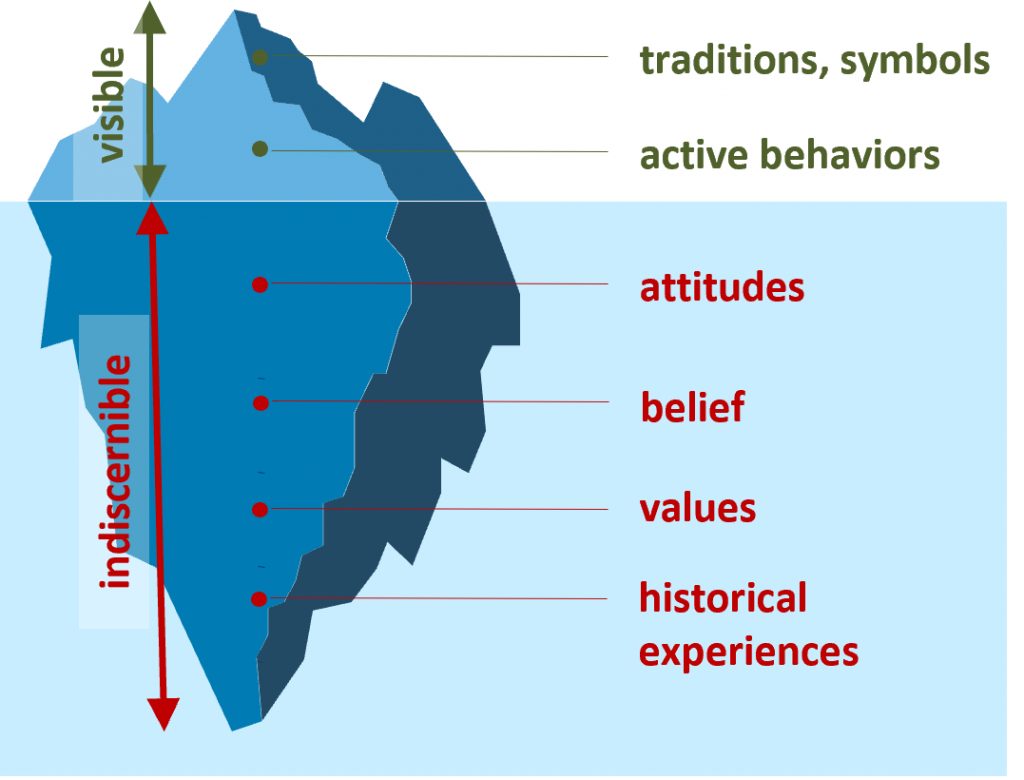
The SCSR is grounded in the understanding that the most influential drivers of safety performance lie below the surface.
Visible elements such as rules, procedures, symbols, and observed behaviour are only the tip of the iceberg.
Beneath them lie:
- attitudes
- beliefs
- values
- historical experiences
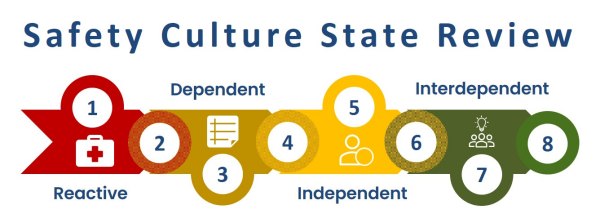
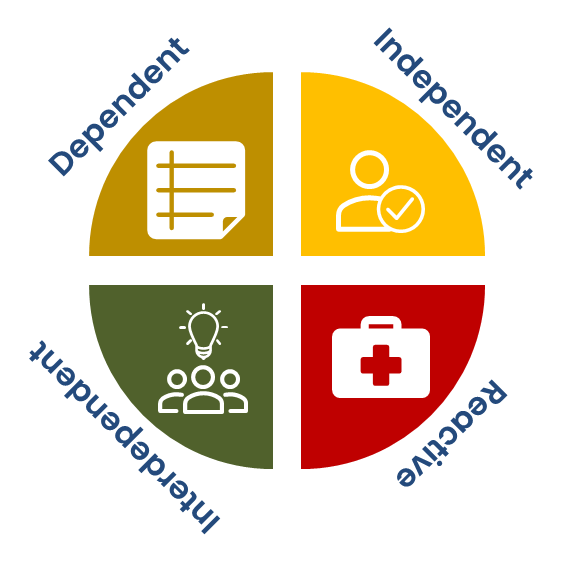
The Safety Culture State Review uses a structured maturity model combining:
- Covey’s maturity levels (dependent, independent, interdependent),
- extended by Bradley’s “reactive” level,
to create a clear link between cultural maturity and safety performance.
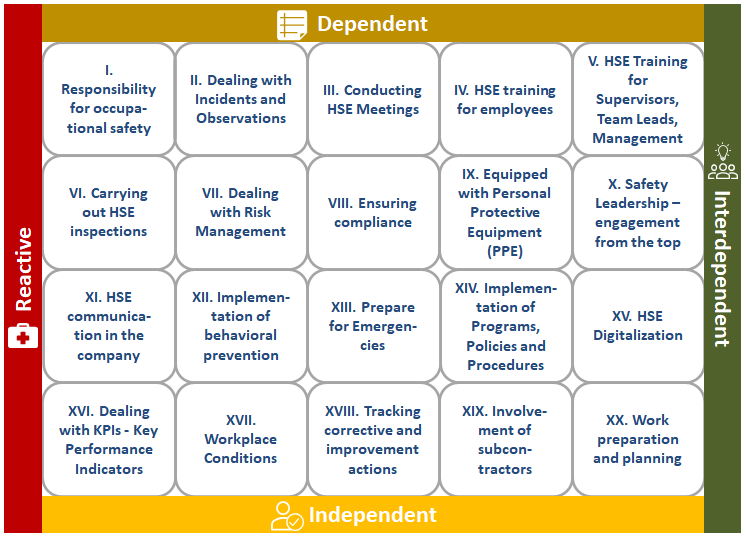
By assessing behaviours across defined dimensions, the SCSR translates invisible cultural drivers into discernible maturity levels, enabling:
- focused leadership dialogue,
- prioritisation of development efforts, and
- measurable progress over time.
From Cultural Insight to Accident Prevention

The purpose of the SCSR is not classification — it is prevention.
By understanding how culture influences safety in practice, organisations can:
- identify cultural risks early,
- strengthen leadership effectiveness,
- improve decision-making under operational pressure, and
- reduce the likelihood of major and high-consequence accidents.
The Safety Culture State Review connects culture, behaviour, and safety outcomes — and transforms cultural insight into practical, preventive action.
The four stages of Safety Culture
20 dimensions that significantly influencing the companies’ safety culture
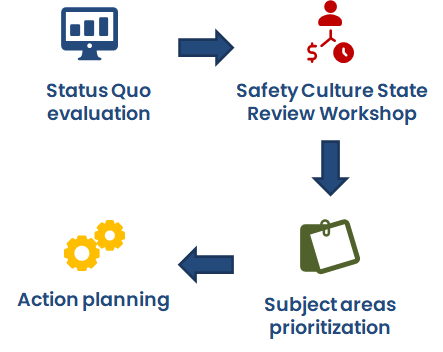
Carrying out a Safety Culture State Review Survey
 English
  German